

Let’s get the obvious bit out of the way. When Australian 4X4ers hear that a Bronco is finally coming here, this probably isn’t the vehicle they picture. The Bronco name still conjures images of chunky tyres, low-range gearing, removable doors and the sort of proper off-road hardware designed to take a fight to the Jeep Wrangler. Instead, Ford Australia has confirmed the Bronco Basecamp, an electrified monocoque SUV aimed squarely at outdoorsy buyers rather than hardcore 4X4ers.
That distinction matters. Ford describes the Basecamp as a vehicle for trail runners, gravel cyclists, campers and others who want to escape into the outdoors. So far, it hasn’t announced the sort of detailed off-road hardware that would convince us this is a replacement for a Ranger, Everest or traditional Bronco on difficult tracks. But perhaps judging it against those vehicles misses the point entirely.
Plenty of Australian touring doesn’t involve lockers, 35in tyres and crawling through bonnet-deep mud. It involves long highway hauls, corrugated gravel, fire trails, national park tracks and campsites a few hundred kilometres from home. For that kind of travelling, the Bronco Basecamp could become surprisingly relevant.
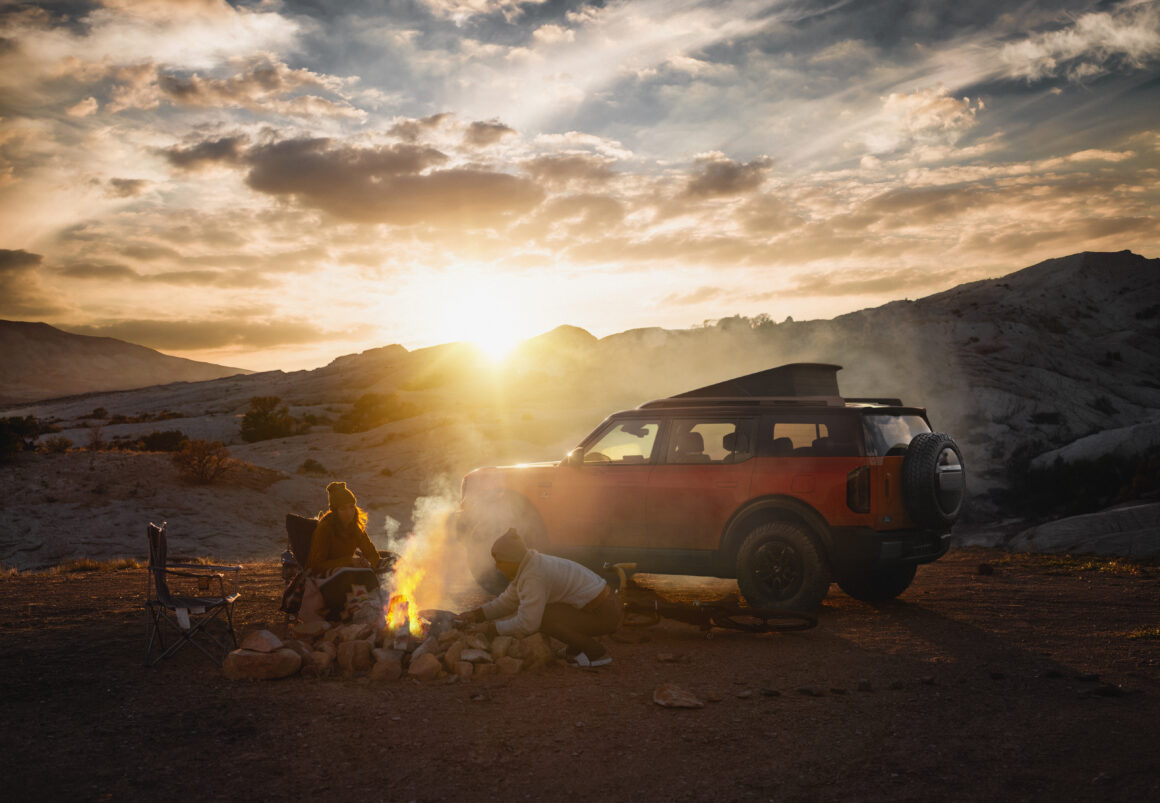
An interesting drivetrain for long-distance touring
The most unusual part of the Bronco Basecamp is its powertrain. Ford calls it a “super-hybrid”, combining dual-motor electric propulsion with a usable 49kWh battery and a 1.5-litre turbo-petrol engine. Importantly, that petrol engine acts purely as a range extender rather than mechanically driving the wheels. Ford currently estimates a combined driving range of between 800 and 900 kilometres.
That could be an excellent formula for Australian touring. Pure EVs still create some genuine headaches once you start heading away from the major highways, particularly if your destination involves small towns, remote campsites or charging infrastructure you can’t confidently rely on. A petrol range extender dramatically changes that equation. You get electric driving without being completely dependent on finding a charger halfway through the trip.
Dual electric motors also have potential advantages away from the bitumen. Electric motors can deliver incredibly precise torque control, particularly on loose gravel and slippery surfaces. We’ll need to see exactly how Ford calibrates the Basecamp, along with details such as clearance, tyres, traction systems and water crossings, before making any serious judgement about its off-road credentials. Still, as a dirt-road tourer rather than a rock crawler, the basic ingredients look interesting.
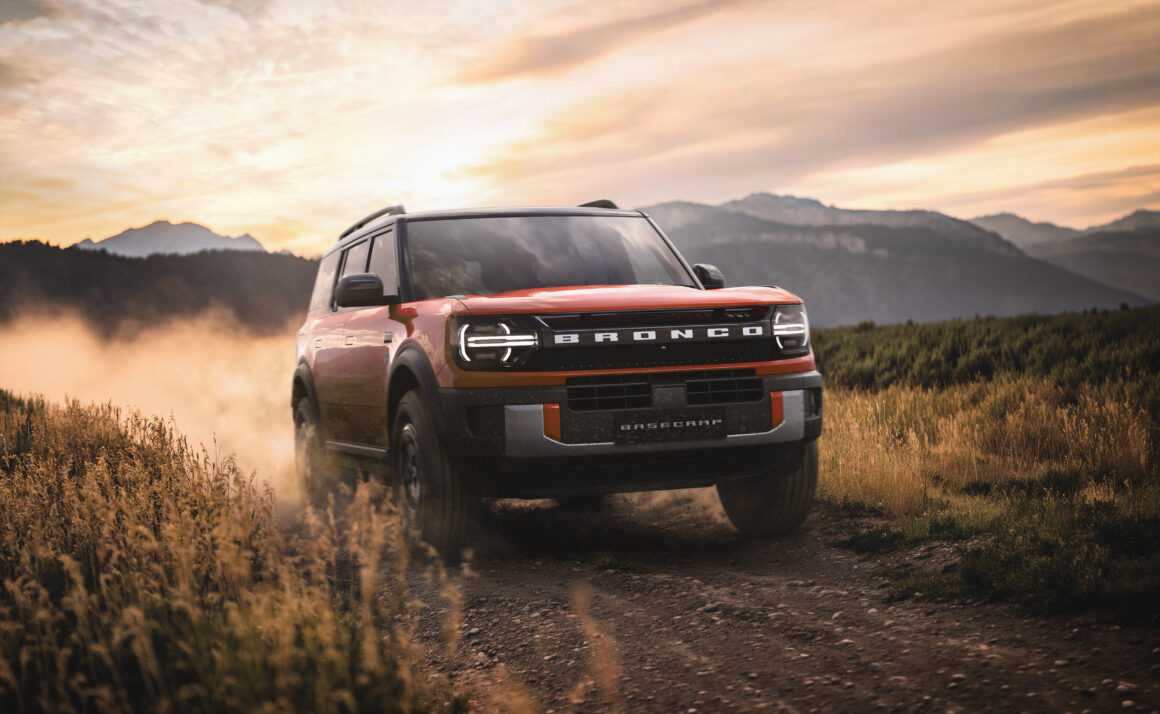
It might actually be a clever camping wagon
Ford has clearly designed the Bronco Basecamp around camping rather than expecting owners to bolt half an accessory catalogue onto it. The cabin converts into a sleeping area, with an available full-length inflatable mattress, while Outer Banks versions score an electrically operated pop-up roof that increases interior headroom and ventilation. There’s also an integrated 7.5-litre heating and cooling compartment in the centre console.
Around the back, Ford has fitted what it calls the Wild Kitchen into the swing gate, including a fold-down preparation table. More interesting for touring is Pro Power Onboard, which can deliver up to 6.6kW from the vehicle’s battery. That’s enough capacity to completely change how you set up camp, potentially running induction cooking, lighting, laptops, camera equipment and other appliances without carrying a separate generator or large secondary electrical system.
That integrated approach makes plenty of sense for people who want to travel rather than build a dedicated off-road weapon. Drive somewhere Friday afternoon, head down a gravel road, pull up at camp, open the back and you’re largely ready to go. There’s something appealing about that simplicity.
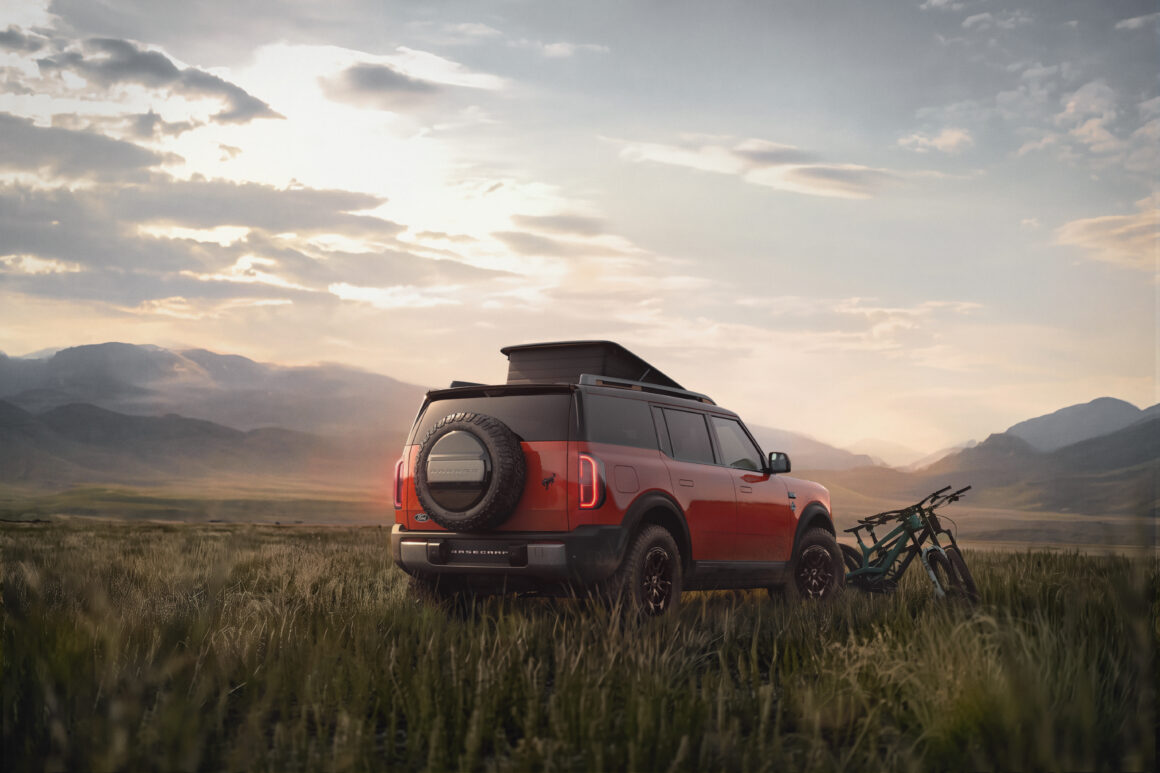
The price could decide whether it makes sense
And this is where the Bronco Basecamp becomes particularly interesting. Australian households are under serious financial pressure, and the days of casually buying an expensive 4X4 before throwing another $50,000 worth of suspension, electrical gear, storage and camping equipment at it are getting harder to justify. Ford hasn’t announced Australian pricing yet, so whether this argument stacks up will depend heavily on where the Basecamp lands.
If it arrives at premium-EV money, it’ll be difficult to make a case for it. But if Ford can keep the price realistic, the integrated camping equipment and onboard power could reduce the amount owners need to spend after leaving the dealership. Suddenly, the question isn’t whether it can follow a modified Ranger through a deeply rutted High Country track. It’s whether it can comfortably carry a couple down hundreds of kilometres of gravel and let them camp when they arrive.
The Bronco Basecamp isn’t the Bronco many Australian 4X4 enthusiasts have spent years hoping Ford would sell here. We’d still happily take the real thing. But for the huge number of Australians whose adventures involve highways, dirt roads, national parks and relatively mild tracks, this might ultimately prove more useful than its name initially suggests. Ford says Australian arrivals will begin in the second half of 2027, with pricing and final local specifications still to come.


4 comments
I am interested In the updates of Bronco Basecamp
Dear Ford, Mazda, Suzuki & Toyota,
Will ONE of you please make a single model of SIMPLE, low tech 4WD – design it around reliability and feature all-terrain tyres, a gearbox with dual range and a low-range gear lever, 1,000-1200Km range in standard form. No electric motors or hybrid-electric. No AdBlue. Vinyl interior so I can wipe it clean. Absolute minimal electronics too.
I was watching the Leylands on Cape York again the other day, and their PETROL Series 2 Land Rovers were flooded literally to the dashboards. They winched to the other side, changed the oils and kept going. I watched Ronny Dahl & friends doing the same trip absolutely panicking when the water hit the doors of their $150,000 Ineos & Troop carrier. I wish my PX2 Ranger could handle a crossing like that – but flood the interior & the carpet will rot & the electronics are dead. Car will likely throw a code & expire right there on the track. Oh what have we become in 2026?
Dear Ford, Mazda, Suzuki & Toyota,
Will ONE of you please make a single model of SIMPLE, low tech 4WD – design it around reliability and feature all-terrain tyres, a gearbox with dual range and a low-range gear lever, 1,000-1200Km range in standard form. No electric motors or hybrid-electric. No AdBlue. Vinyl interior so I can wipe it clean. Absolute minimal electronics too.
I was watching the Leylands on Cape York again the other day, and their PETROL Series 2 Land Rovers were flooded literally to the dashboards. They winched to the other side, changed the oils and kept going. I watched Ronny Dahl & friends doing the same trip absolutely panicking when the water hit the doors of their $150,000 Ineos & Troop carrier. I wish my PX2 Ranger could handle a crossing like that – but flood the interior & the carpet will rot & the electronics are dead. Car will likely throw a code & expire right there on the track. Oh what have we become in 2026?
Dear Luddite I have been reading letters like yours for at least 30 years – “bring back vinyl seats”, “bring back steel rims”. The problem is that every car like that which has actually been marketed in Australia has failed to sell: people don’t want them.