

Ford has spent years proving the Ranger platform can be pushed well beyond the limits of a conventional dual-cab ute. Ranger Raptor showed what happens when you chase performance, Ranger Super Duty took aim at serious commercial payload and towing, and now Ford has gone one step further by bolting another axle onto the back.
This time, it isn’t just a render buried in a military presentation. Ford has built a genuine Ranger Super Duty 6×6 concept and is taking it out into the world to see what people think.
That distinction matters. This isn’t a production announcement and Ford hasn’t promised you’ll be able to order one from a dealer. The concept is effectively a temperature check. If enough customers, fleets and specialist operators show genuine interest, there’s a chance the idea could move forward. If the reaction is lukewarm, it could remain an engineering exercise.
For Australian tourers, though, the potential is enormous.
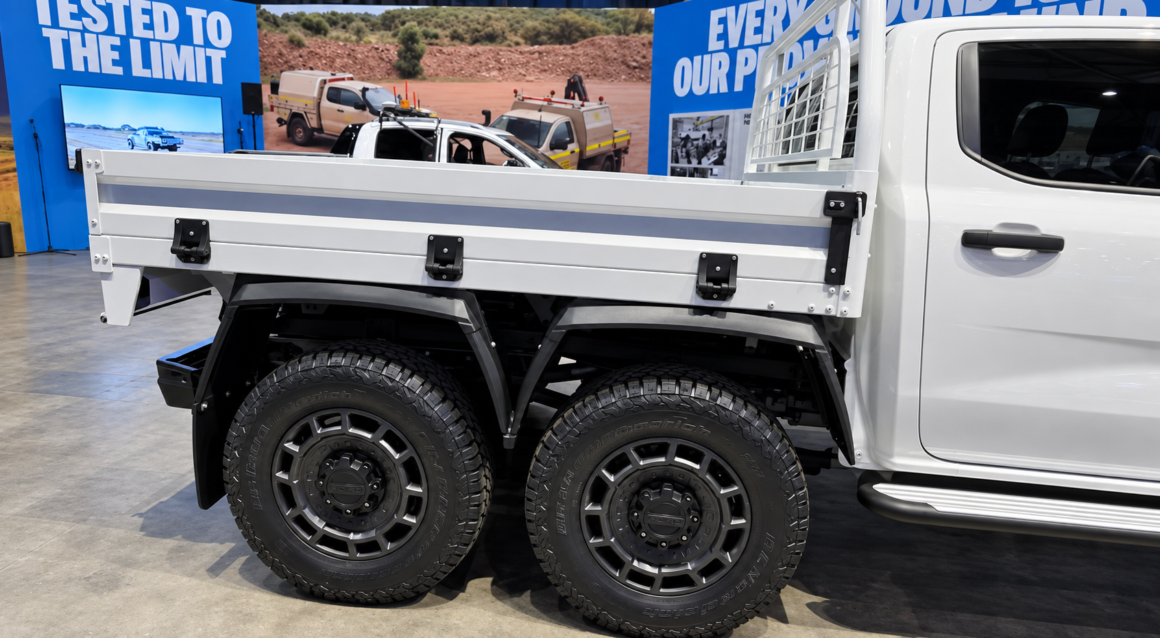
A 6×6 designed as an add-on
Perhaps the most interesting part of the Ranger Super Duty 6×6 is how Ford has approached the conversion. Rather than designing an entirely new six-wheel vehicle from scratch, the additional axle has been developed around the existing Super Duty platform.
In other words, the concept is much closer to a modular conversion than a clean-sheet 6×6.
That inevitably means there are compromises. A purpose-built six-wheel vehicle could use more elaborate load-sharing suspension and optimise every part of the chassis around three axles from the beginning. Ford’s concept instead demonstrates just how adaptable the standard Ranger Super Duty architecture has become.
And that versatility might be more important than absolute optimisation.
Ranger Super Duty already starts with the kind of heavy-duty hardware most owners would otherwise have to engineer into a conventional ute. Add another driven axle and suddenly there’s an opportunity to dramatically increase load-carrying capability, stability and traction without stepping straight into a traditional light truck.
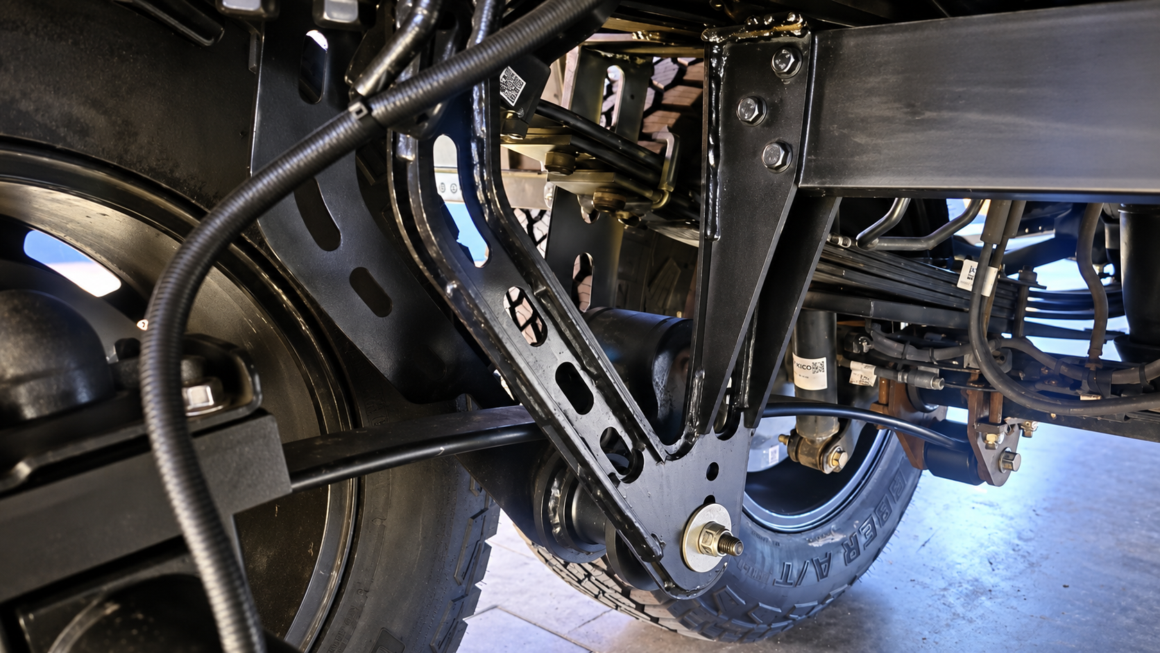
Why an extra axle matters
Australian companies have been converting utes into six-wheelers for decades, and there’s a reason they keep doing it.
The obvious advantage is payload. Adding another axle and another pair of tyres gives the vehicle more capacity to support weight, which becomes particularly valuable once you start fitting large service bodies, heavy canopies, recovery equipment or camper conversions.
Stability can improve too. With four rear tyres supporting the vehicle and more opportunity to position heavy loads ahead of the rear-most axle, a 6×6 can feel considerably more planted under load. That same stability could also become useful when towing.
Then there’s off-road performance. A true 6×6 gives you another driven axle and two more tyres sharing the vehicle’s weight. On soft surfaces such as sand, that extra tyre footprint can make a significant difference without increasing the vehicle’s mass by the same proportion.
That doesn’t mean six wheels automatically make everything better. More tyres also mean more scrub in tight turns, increased rolling resistance and extra mechanical weight. A 6×6 Ranger Super Duty would be longer, less manoeuvrable and thirstier than the four-wheel version, while the existing V6 diesel would have more mass to move.
But for some jobs, those compromises are very easy to accept.
This could be the camper platform we’ve been waiting for
The touring potential is where the Ranger Super Duty 6×6 gets properly interesting.
Australian 4X4 builds keep getting heavier. A big canopy, long-range fuel, water, batteries, solar, spare tyres, recovery gear, tools and camping equipment can consume the payload of a conventional ute frighteningly quickly. Add a large camper body and you can easily reach the point where a light truck begins to make more sense.
The problem is that light trucks come with their own compromises. Vehicles such as a Fuso Canter or Hino offer enormous carrying ability, but they generally don’t provide the same combination of ride quality, refinement, automatic transmission performance, safety technology and everyday drivability as a modern Ranger.
A factory-developed Ranger Super Duty 6×6 could potentially sit right in the middle.
Imagine a lightweight expedition body behind the cab with sleeping accommodation, water, lithium batteries, solar, fridge, kitchen and enough storage for weeks away. Instead of towing a caravan or camper trailer across the outback, everything could live on one platform.
The longer chassis could also allow the camper body to sit more intelligently relative to the rear axles, reducing the huge rear overhang seen on some large ute-based campers. That could improve weight distribution, stability and potentially departure angle depending on how the body was designed.
At that point, you’re no longer talking about an overloaded dual-cab with a big canopy. You’re getting surprisingly close to a compact expedition truck with Ranger comfort and drivability.
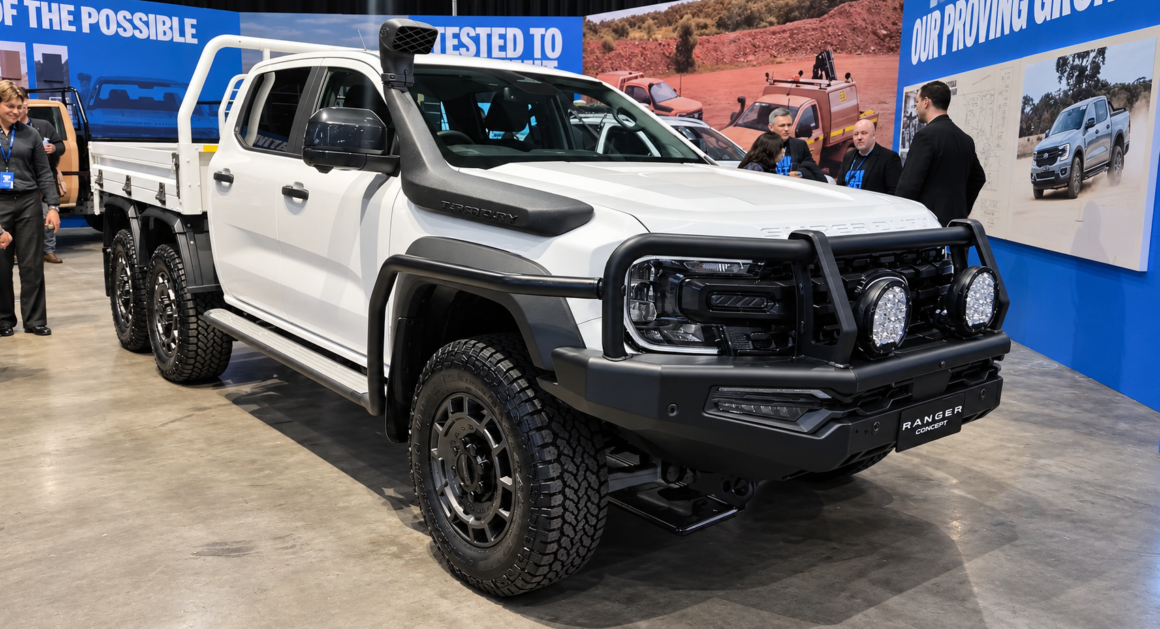
The factory backing could be the real advantage
There are already companies willing to build you a six-wheel ute, so Ford wouldn’t be inventing the concept. What could make a production Ranger Super Duty 6×6 different is integration.
If Ford decided to put the conversion into production, it could engineer the electronic stability control, ABS, traction systems, driveline calibration and other vehicle systems around the six-wheel configuration rather than asking an aftermarket converter to work around them.
A factory-supported system could potentially simplify warranty, servicing and parts supply too. That would be especially attractive to commercial fleets, emergency services, mining companies and remote-area operators that care just as much about downtime as they do outright capability.
There would still be regulatory realities. If a future version pushed beyond 4.5 tonnes GVM in Australia, it would move outside normal car-licence territory and into light-truck licensing requirements. That alone would limit its appeal to some recreational buyers.
For the people who genuinely need the capacity, though, that probably won’t matter.
Ford wants to know if anyone actually wants one
That’s ultimately where the Ranger Super Duty 6×6 sits today. Ford has built it, but Ford hasn’t committed to selling it.
The concept will appear in front of potential customers and the reaction will help determine whether there’s enough demand to justify taking the next step.
Considering the money Australians already spend turning dual-cab utes into long-range tourers, six-wheel conversions and compact expedition vehicles, we suspect there will be no shortage of people willing to explain exactly what they’d do with one.
Ranger Super Duty already blurred the line between ute and light truck. Add another driven axle, a properly engineered camper body and factory integration, and that line becomes harder to see again.
If Ford does decide to build it, the Ranger Super Duty 6×6 could end up being one of the most interesting all-in-one outback touring platforms we’ve seen in years.



2 comments
A well balanced article, thankyou. It’s a hard decision, but I feel that the government should aim for zero horses in national parks.
From the undercarriage photo it looks like ground clearance on the 6X6 would be an issue…