

Corrugations are an unavoidable part of travelling Australia’s unsealed roads. They form as tyres disturb loose material and suspension movement repeatedly shapes it into ridges, creating anything from a mild vibration through the steering wheel to a relentless hammering that shakes vehicles, trailers and occupants for hours.
The temptation is to search for one perfect tyre pressure or speed that makes them disappear. Unfortunately, corrugations change with the road surface, traffic, weather and even from one side of the track to the other. Mastering them is less about memorising a number and more about reading the surface, making small adjustments and knowing when conditions demand that you slow down.

Start with the tyres
Tyre pressure is the first useful adjustment because the tyre is the initial part of the suspension system. Reducing pressure allows the casing to flex and follow the surface instead of bouncing across the ridges. As a conservative starting point, many drivers reduce cold highway pressures by roughly 20 per cent. A 4X4 running 36psi might begin around 28–30psi, then adjust for tyre construction, weight, speed and conditions.
Going lower is not automatically better. Reduced pressure creates more sidewall flex and heat, particularly when speed and weight remain high. It also raises the risk of damaging a sidewall, wheel or bead. Check the tyres while travelling and remember that rising hot pressure is normal. If they become excessively hot, reduce speed before reaching for the deflator again.
Don’t forget the trailer. Its ideal pressure depends on the load it carries, not simply the maximum printed on the sidewall. Too much pressure encourages bouncing, while overloading or underinflation creates heat. Correct pressures also reduce punishment to bearings, mounts and everything packed inside.

Find the safe rhythm
There’s often a speed at which the ride smooths out because the tyres begin skimming across the corrugations. That doesn’t make it the correct speed. Grip and braking ability may be falling away as the cabin becomes more comfortable, leaving the vehicle vulnerable to a bend, washout, animal, or deeper gravel.
Build speed gradually and judge the whole vehicle. If the steering feels vague, the rear steps sideways or the vehicle stops responding cleanly, back off smoothly. Never outrun the distance you can see and stop within. The suitable speed can change around the next bend, so reassess whenever the road surface changes.
On loose roads, high-range four-wheel drive can improve stability by sharing drive across both axles. Part-time 4H belongs on loose surfaces and should be disengaged before returning to firm bitumen. For full-time 4WD or 4A, follow the vehicle handbook.
Keep every input smooth
Corrugations reduce consistent tyre contact, so abrupt steering, braking and throttle inputs can quickly unsettle the vehicle. Look ahead, slow before corners and steer gently. Maintain light throttle through a bend rather than charging in and braking halfway around. If the rear moves, ease the throttle and make measured corrections.
Leave a larger gap for braking and visibility through dust. Avoid another vehicle’s dust cloud, where traffic, cattle grids and washouts can appear without warning. Ease off early and brake progressively because skipping tyres can activate ABS without delivering bitumen-like stopping performance.
Adjustable suspension can help, but turning every adjuster towards soft is not guaranteed to improve the ride. Different adjusters control different parts of damper behaviour. Begin with the manufacturer’s middle setting, change only a few clicks at a time and test. Aim for controlled wheel movement without harshness, bottoming, or wallowing.
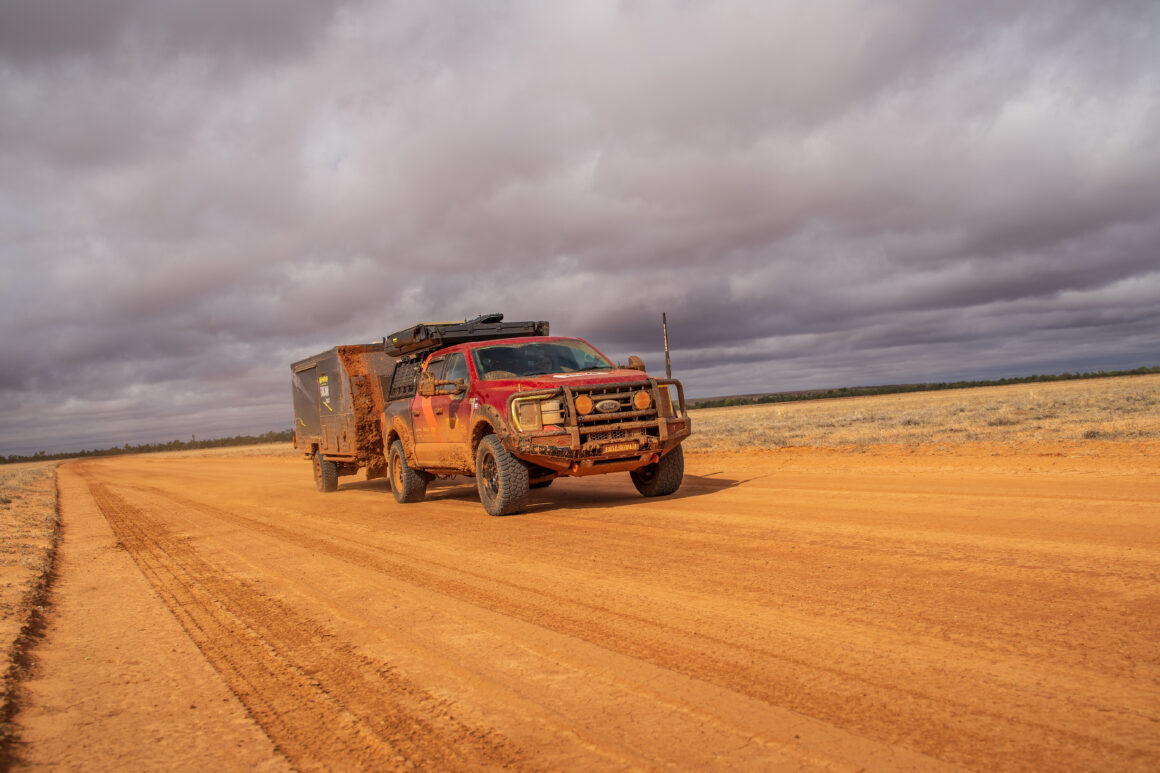
Manage heat, fatigue and damage
Shock absorbers turn movement into heat, and long corrugated sections can make them overheat and fade. As damping falls away, the vehicle may bounce, pitch, or wander even though speed hasn’t changed. Slow down and stop somewhere safe. Letting the dampers cool is cheaper than destroying seals or continuing with poor control.
Corrugations also attack fasteners, brackets and cargo. At rest stops, check wheel nuts, tyres, shock absorbers, roof racks, battery mounts, spare wheels, and bar work. Look for leaks, loose straps, and hot hubs. Pack heavy items low and secure them properly; storage must restrain its contents, not just organise them.
Finally, manage the driver. Constant vibration, noise, and concentration are exhausting, and fatigue encourages poor decisions. Swap drivers, take regular breaks, and accept that some roads simply require patience. The goal isn’t to discover how quickly your suspension can cross the corrugations. It is to reach the other end with your vehicle intact.