Australia has some of the worst diesel in the developed world. So we look at secondary fuel filters and how they can help save your engine.

There are more than a few secondary fuel filters on the market these days. Especially so with the proliferation of common-rail diesel engines. Tolerances within the fuel injection system have become so minute, that the smallest debris or contamination can cause injector damage or malfunction and potentially destroy an engine.
In this article, we’ll look at what a secondary fuel filter kit does. The different types of filter kits available. The different sizes of filters; and how installing a secondary fuel filter kit can stave off disaster.
THE FACTORY FUEL FILTER
All of our four-wheel drives will have a fuel filter in them. They’re usually under the bonnet, have a water trap to catch water, a sensor to detect any water; and should get replaced at every other service.
There are a few things to consider with filtering ability. An OEM filter is usually around the 10 – 12-micron mark (0.01 to 0.012mm), but not exclusively greater than 10; sometimes as small as five microns. So they will filter out exceptionally small particulates and debris. In a perfect world that’d be job done. Unfortunately, particles as small as two to five microns can cause issues in the fuel system of common-rail diesel engines.
So what aftermarket options are available to help ensure we’re getting the cleanest fuel into the engine as we can?
PRE VS POST FILTER

A Flashlube pre-filter. Diesel runs from the tank to the pre-filter, then into the factory filter, before ending up at the injector pump.
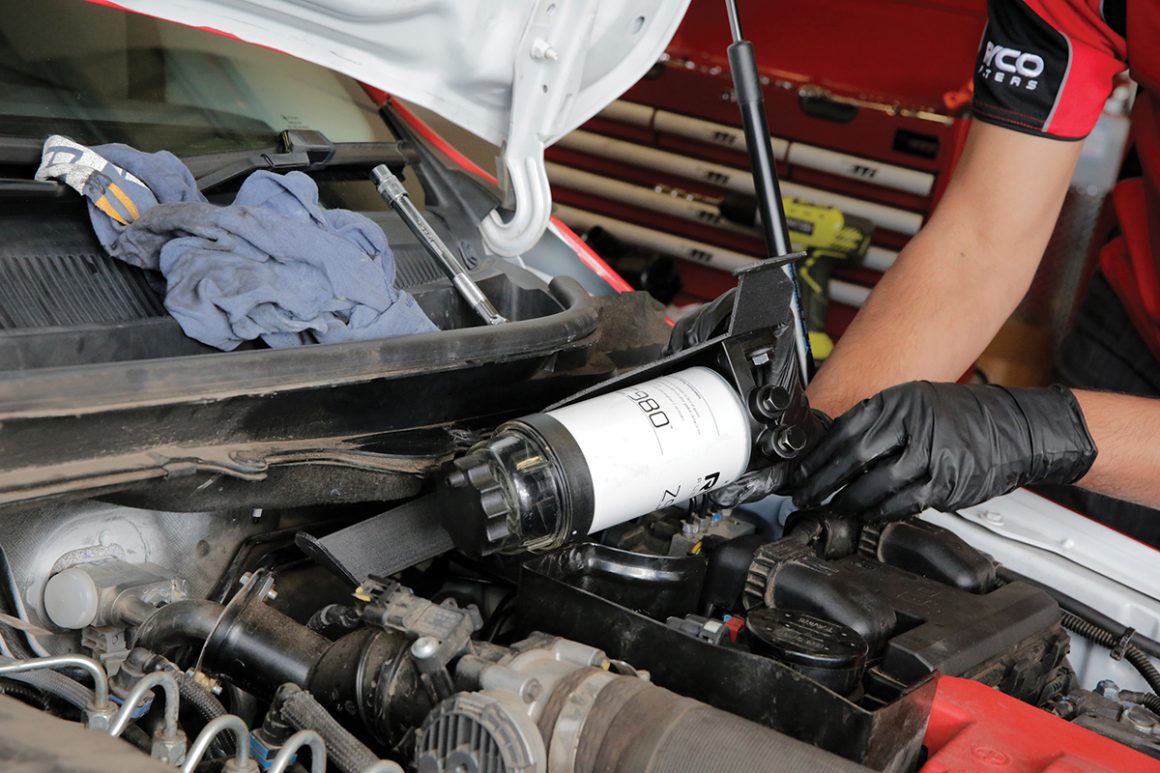
You’ll see the aftermarket pre-filter on the left side of the engine bay. The lines that run along the firewall are where it taps into the OEM filter.
There are two options for secondary fuel filters on the market – pre and post (final) filters. As they sound, one is installed before your factory filter (pre-filter), and one after (post/final filter). There are good arguments for both sides, which we will discuss further into the article.
Generally, the pre-filter will be somewhere in the vicinity of a 30 – 40-micron filter. They’re designed to capture more substantial contamination before it gets to your factory filter. They also include a water trap, to catch any water that’s been brought up from your fuel tank. Being the larger size, they catch a lot of the larger particles and will keep your factory fuel filter cleaner, longer.
The post-filter has a much finer filter and will stop particles between two to five microns getting into your fuel system. They also include another water trap as well. Most vehicle manufacturers state that anything below their factory filter size (below five to 10 microns as an example), will not upset the fuel system. That’s the injectors, pump, and engine.
There has been quite a bit of debate as to which option is the best. We’ll explore the reasoning below.
THE BETTER OPTION?
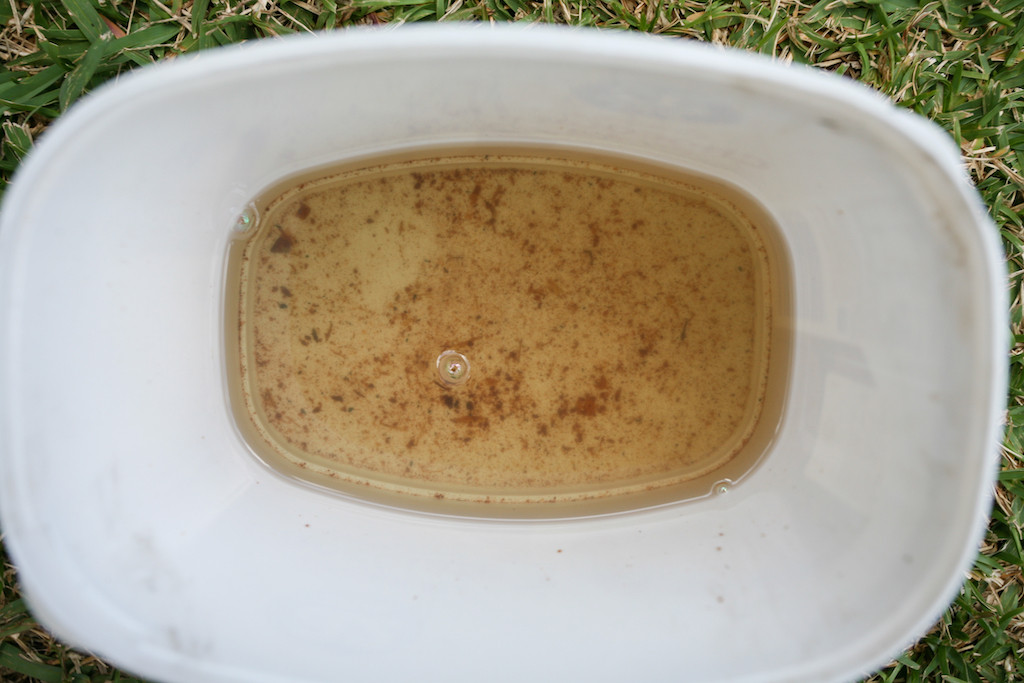
This is the bigger particulate matter the pre-filter stops from running into your factory filter. Top-quality diesel we have Down Under…

Note the gunk at the bottom of the factory 1VD-FTV fuel filter canister. We took this photo before fitting a pre-filter.
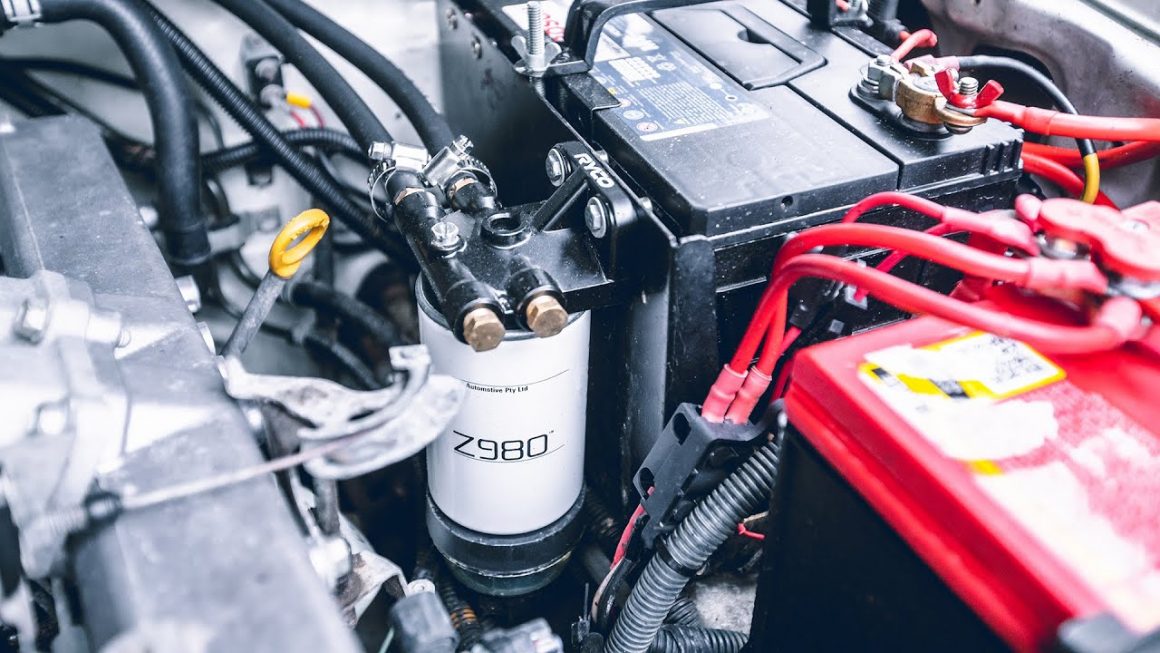
The clear bowl on the bottom of the filter traps water, and lets you drain the bowl should you get a load of water in your fuel.
The debate as to which is the better option has gone on almost as long as there have been diesel engines. We already know the differences, so why would you install a pre-filter, over a post-filter, or vice versa? On the one hand. The pre-filter will pick up the bigger contaminants, and they’ve got a glass bowl water trap, which traps water, and can be visually checked. This will keep your OEM filter cleaner, longer, and should stop a lot of the water getting to your OEM filter sooner, by the time the factory light/buzzer goes off for the water trap having water in it. On the other hand, a post-filter picks up the smaller contaminants and also has a water trap. Your OEM filter still gets the larger particles and will clog up sooner with this, however only particulate matter smaller than two microns will get through the filter.
MY PERSONAL PREFERENCE
Now don’t get me wrong, I own a dirty old 80 Series LandCruiser mechanical diesel, where you can just about lob a tin of Heinz soup into the fuel tank, and it’ll keep running without an issue.
However, for common-rail diesels, in the past, I have run a post-filter as opposed to a pre-filter for a couple of reasons. First and foremost, I change my fuel filters every second service (10,000km). So keeping filters clean, and replacing them is on me, not on a pre-filter. And second, with the inbuilt water trap, by the time my ‘water indicator and buzzer’ go off, I’ve still got the water bowl in the post-filter to fill up. Which gives me time to pull over, shut the engine down, and drain the bowl. Having a pre-filter without an inbuilt buzzer, by the time the factory alarm goes off, water will be quickly getting into the fuel system and breaking things.
Something else worth thinking about is vehicle manufacturers’ ‘within specification’ responses. Most of us would recall the Toyota issues with dust getting past the factory air filter. There’s been more than a few D4-D 2.8-litre HiLuxes go into limp mode as the Mass Air Flow sensors have been covered in dust. There has also been a few that have had “dusted engines” – where dust has caused scoring on internal components and caused premature engine failure. This is all despite Toyota unequivocally stating that the dust getting past the factory air filter was too small to cause damage.
Add this same manufacturer logic to “anything smaller than 10 – 12-micron particulate matter will not harm your fuel system”. It’s not that I don’t trust the manufacturers, but I’d rather be doubly safe, especially due to how much we invest in our vehicles.