WORDS BY CARAVAN COUNCIL OF AUSTRALIA, IMAGES BY TOMMY SALMON
ADVICE: CARAVAN TYRES
Professional automotive engineer Colin Young P.Eng from the Caravan Council of Australia reckons many have got it wrong
Tyres play a critical role in determining the Handling and Stability characteristics of all caravans on the road. On a few frightening occasions, the tyres selected by a ‘van manufacturer have been dangerously “under-engineered”, in that their Maximum Load Rating was less than the Maximum Load that the tyres could legally (as per the GTM Rating) be subjected to!
In far too many cases, the tyres selected by the ‘van manufacturer have been hideously “over-engineered”, in that their Maximum Load Rating was much higher than the Maximum Load that the tyres would ever be subjected to!
While there may be some other opinions on how much a tyre should be loaded to, for caravan tyres it is reasonable to have the maximum Load applied to a tyre, at around 90 – 95% of the Rating. Certainly, it should not be around 50 – 60%.
“BIGGER ain’t always BETTER”… certainly applies to caravan wheels and tyres.
If you are not happy with the way your ‘van handles on the road, or if you have any other concerns about your ‘van’s Tyre Size or Inflation Pressures, you should discuss the issues with the ‘van Manufacturer – and also seek the advice of a professional Tyre specialist – to best-ensure that the fitted tyres are, or are not, of the optimum specification.
 Taller tyres also means better ground clearance, but it’s about finding the right balance
Manufacturers often state the “Recommended Inflation Pressure” – for the Full-Loaded Condition – as the “Maximum Permitted Pressure” that is embossed on the tyre sidewall… even though the tyres are only loaded to a fraction of their Rating!
No wonder the ‘van then skips and bounces around on the road, the ‘van vibrates horribly, and the central portion of the tyres’ tread wears out very quickly.
Sometimes manufacturers state the “Recommended Inflation Pressure” – for the Full-Loaded Condition – as the “Stated Pressure” for that particular tyre size, when subjected to the actual maximum load… as prescribed in the Tyre and Rim Association of Australia’s “Standards Manual”.
No wonder the ‘van then sways and wallows around on the road, and the outer portions of the tyres’ tread wear out very quickly.
Neither situation is satisfactory with respect to safe and predictable handling and road-holding.
If only one inflation inflation pressure is stated, you need to seriously question the ‘van manufacturer’s knowledge of suspensions and tyres.

The “Tyre Placard” – which is usually incorporated in the “Trailer Plate” – is a vital part of a caravan.
The intent of affixing a Tyre Placard to a caravan is to provide an Assurance from the Manufacturer – to a potential-buyer that the selected tyre Size and Load Rating – along with the recommended Tyre Inflation Pressures – have been professionally determined, so as to provide the optimum caravan handling and stability performance, at both the empty and the fully-loaded conditions.
Sadly, for many caravans, this is clearly not the case. Incorrect information has been the prime cause of many complaints of unacceptable – and often dangerous – caravan handling and stability problems… and all too often, serious accidents.
The Tyre Placard must show at least the following information:
• Caravan manufacturer’s recommended (complete) tyre Size and Description… Diameter, Width, Construction, Aspect Ratio
• Tyre Load Rating
• Tyre Speed Rating
• Cold Inflation Pressures
The Tyre Load Rating must be stated in kg.
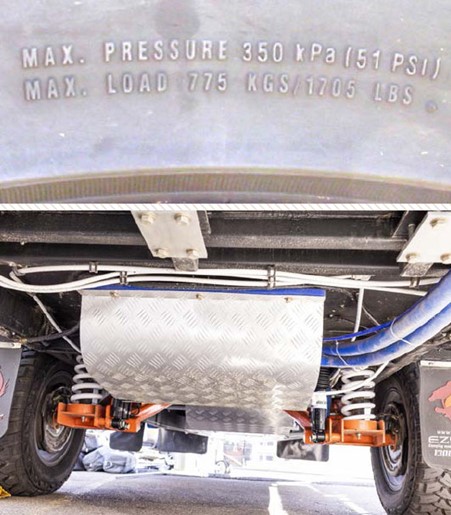
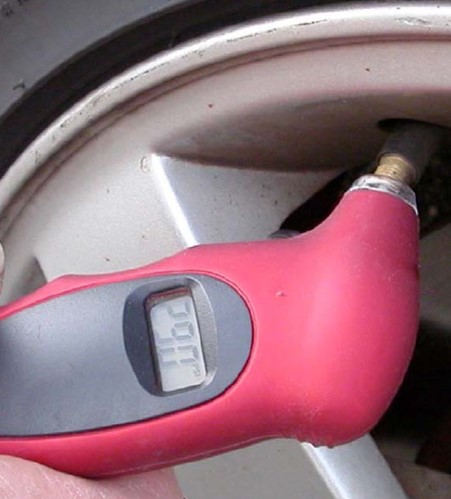
The Tyre Inflation Pressures must be stated in kPa.
For load-sharing suspension systems, the maximum legal individual Tyre Load equals the GTM Rating divided by the Number of tyres fitted to the ‘van.
The individual Tyre Load – when the ‘van is empty – equals the (Tare Mass minus the Empty Ball-Loading) divided by the Number of tyres fitted to the ‘van.
If – as is often the case – your ‘van’s “Empty Ball-Loading just “happens” to equal the ATM Rating minus the GTM Rating” or the “GTM Rating just “happens” to equal the ATM Rating minus the Empty Ball-Loading”, it is vital that you seriously question the ‘van manufacturer, as to how the GTM Rating and the Empty Ball-Loading were determined.
You simply cannot compare (fixed, allocated Ratings… which are maximum limits applicable only for the fully-loaded condition) with Actual Masses, such as the Ball-Loading and the Axle-Loading, that vary, depending on how the ‘van is loaded!!!
For non-load-sharing suspension systems (on tandem-axle ‘vans), the front and rear tyres will have different loadings, if the ‘van is not level (in a side view).
For maximum traction – and maximum tread life – the loading needs to be spread evenly across the full width of the tread.
This can only be achieved if the correct inflation pressure is used… so that the tread is at the same temperature across its full width.
Larger tyres mean heavier loads with spares weighing into the argument. Although matching van and vehicle tyre and rim size has always been seen as a smart idea for remote touring and may limit the need for additional spares
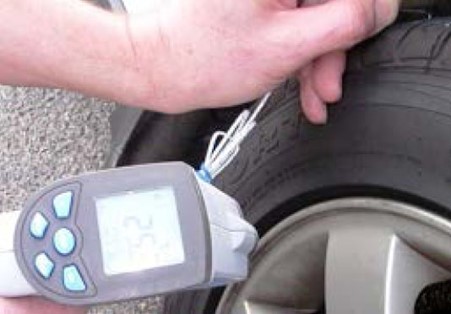
The Effect of Different Tyre Inflation Pressures on Traction, Ride & Handling of the caravan, and Wear (Life) of the Tyre
Under-inflation:
If a tyre is not inflated up to the Pressure that is required to match the actual tyre Loading, the tyre tread will not have full contact with the road surface, causing the outer portions of the tread to be subjected to increased loading, with subsequent increased temperatures and increased wear.
The traction between the tyre and the road surface will be decreased, and the sidewalls of the tyre will significantly flex, causing the ‘van to wallow and sway.
Over-inflation:
If a tyre is inflated above the Pressure that is required to match the actual tyre Loading, again the tyre tread will not have full contact with the road surface, this time causing the centre portion of the tread to be subjected to increased loading, with subsequent increased temperatures and increased wear.
Again, the traction between the tyre and the road surface will be decreased, causing the tyre to bulge, and the ‘van to bounce and skip.
In both cases, the handling and stability of the ‘van will be impaired, and the tyre life appreciably reduced. While most of the tread will have plenty of kilometres of travel remaining, the outer peripheries of an under-inflated tyre will be worn down to the Tread Wear Indicators, thus rendering the tyre unroadworthy, while for an overinflated tyre, the inner periphery will quickly be worn down to a dangerous and illegal level.