
Chances are that by now you’ve heard about the issues with Toyota’s most widely used engine, the 1GD-FTV, eating up dust. As promised in last weeks post, we took the investigation just that much further, and asked an expert in automotive filtration for his thoughts on the 1GD-FTV Dustgate saga.
If you happened to miss the previous post, the long and short of it, is that through a design fault in the induction system of the 1GD-FTV engine (used in the HiLux, Fortuner, & Prado), dust particles of “5 microns and smaller” are getting past the air filter, sticking to the MAF sensor, corrupting the sensor readings and causing the 1GD’s to go into limp mode. Limp mode is able to be cleared by resetting the ECU (battery disconnected for five minutes), and Toyota has released a ‘dealer bulletin’ advising service personnel to ‘blow out the MAF sensor when performing services with compressed air’. They are not, however, undertaking a recall on the issue, but have requested that the R&D team look into fixing this issue for future models.
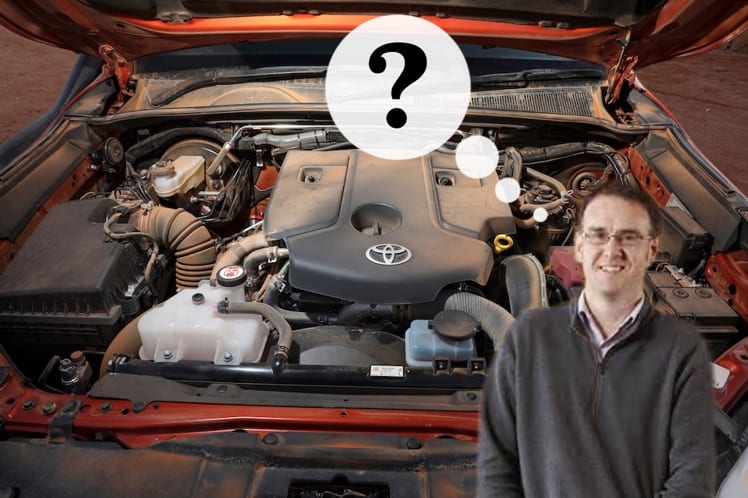
Now, with all that in mind, we got in touch with Ben Mullins from Curtin University, who is an Associate Professor with an interest in testing and researching automotive filtration systems – everything from oil, fuel, and specifically useful for us, air.
We handed over the statements from Toyota Australia regarding the dust ingress, and further to sending the vehicle into limp mode, we asked him what impact it could have on the engine. This is what he told us:
“I am surprised by the comments from Toyota. Firstly, 5 microns is regarded as a “coarse” particle in the air pollution world. It has been shown that fine particles (e.g diesel soot) can cause engine wear. Soot particles are <300 nm (0.3 microns) in size – albeit at high quantities in the oil.”
In other words, if those dust particles are making their way into turbochargers and internal engine components (which they are, as proven by the fact they’re sticking to the MAF sensor, on the wrong side of the air filter and causing ECU issues), they will be definitely contributing to an engine wearing out faster. Ben continues:
“Also, whomever made the comments about more frequent filter replacement/checks or compressed air cleaning is misguided. The issue here is probably the filter sealing rather than the filter itself, so disturbing the filter more frequently would likely make things worse. Proper tests would need to be done to see if the problem is the filter or the sealing, however flat panel filters can be difficult to seal, which is why heavy-duty engines generally don’t use them except for cabin air.”
In other words, constantly changing the filter isn’t going help if the filter system is ineffective. There is a chance that the filter housing isn’t sealing correctly, so dusty air is bypassing the filter. Ben, once again:
“Another common misconception is that changing your air filter more frequently is better for your engine. Air filters are not sieves, so capture the least amount of particles when new, and get better when they load with dust. So if the filter is the problem, changing it more often will let more dust through! Heavy vehicle manufacturers and filter manufacturers recommend changing filter based on pressure drop as this ensures both the longest filter lifespan and the least dust in your engine.”

At the end of the day, what we’re taking from Associate Professor Mullins’ comments, is that it is quite likely the dust ingress will cause long term issues/damage to the Toyota engines. That is despite Toyota Australia unequivocally stating that “dust of that size (5 microns/5000 nanometres) is not known to cause engine damage”. We’re more likely to take the word of an Associate Professor over a wide reaching statement from Toyota’s PR department (unless of course they can prove to us that dust ingress won’t harm an engine).
It will be interesting in the future to see if the engines do not last as long as one would expect from dust ingress, especially after Toyota Australia’s comments.
Do you think that Toyota should be issuing a recall for the 1GD-FTV Dustgate, or just blowing out the MAF sensor per their bulletin? Let us know in the comments below.




1 comment
So what is the solution to this issue, is there an aftermarket product which better seals? I understand not changing filter out so often but how do we fix the sealing. As seen in one of Fouby4diesel video there are greater amount of dust on flat section around edges, so precisely a sealing issue. Any solutions to this?